




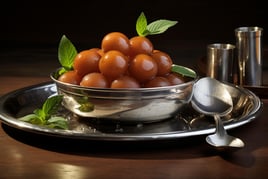


From the classic kaju katli to the tiranga barfi, here are the stories making up the barfi’s many histories and a recipe to make one on your own.

Introduction

Barfi is one of those dishes that has been adapted so much that now, it’s a type or category of dessert more than a single dish. It gets its name from the original malai barfi, where “barf” is the Urdu word for snow, as it matched the snow’s whiteness. Generally made of khoya, sugar, and ghee, this dessert comes in many colors, shapes, and varieties today. Although barfis are popular throughout the country, they’re especially famous in North India, and no celebration or festivity is complete without them.
The Origins of Barfi

The origins of the barfi can be traced back to the Indus Valley Civilization, where people were familiar with the process of fermenting sugar to create sweets. Many experts agree that there were probably sweets made by combining milk and sugar as the base. As writer Sumedha Verma Ojha says, “Sharkara or shakkar is an original Indian product made from sugarcane, and there were many kinds of products and sweets made by mixing this with other ingredients like til, wheat, rice or barley flour.”
Barfi in Temple Prasad
Over the years, barfis have been a popular item in temple prasad. This is largely because of their main ingredients of ghee, sugar, and milk, all of which are beloved of the gods, especially Lord Krishna. Today, there are many types of barfis, from the moong dal barfi to the kaju barfi, and from the coconut barfi to the rose barfi and chocolate barfi. Some of these have interesting origin stories attached to them.
The Story of Kaju Katli

One of the more high-end varieties is the delectable kaju barfi or kaju katli, made of cashews and topped with vark, an edible silver leaf. There are two origin stories behind the famed barfi.
One story goes that the Maratha chef Bhimrao, in the 16th century, was experimenting. He took inspiration from the Parsi sweet Halwa-e-Farsi, replacing the almonds with cashews, and the kaju katli was born. The other story is from the Mughal Empire. Emperor Jehangir had captured several Sikhs, among them Guru Hargovind. He would preach to the other prisoners to make their time in captivity more bearable. So Jehangir set the condition that the Guru would be released, and anyone clinging to his robe when he was leaving would also be released. The Guru ordered monarchs to make a robe long enough that everyone could wear it. On the set day, everyone walked out, and the day came to be known as Bandhi Chor Diwas. Acknowledging the Guru’s ingenuity, Jehangir’s chef created the kaju katli, commemorating the day.
The Origin of Dodha Barfi
Another variety, the dodha barfi, also has a story connected to its origin. In 1912, Punjabi wrestler Harbans Vig had had enough of his ghee and milk diet. He wanted something new, and he started experimenting in the kitchen. In a pan, he added milk, cream, sugar, and ghee, and topped it with nuts. It resulted in a fudge-textured barfi that eventually attained popularity. His family started the Royal Dodha House, which serves the sweet using the original recipe, and that is a closely guarded secret.
The Story of Tirangi Barfi
Another barfi with an interesting story attached to it is the tirangi barfi of Banaras. In 1850, Shri Ragunath Das Gupta had a sweet shop in Banaras. In 1945, his son Shri Madan Gopal Gupta joined him. The son, inspired by the ongoing struggle for independence, wanted to contribute in some way. So he came up with unique names for his sweets, calling them Jawahar Laddoo, Gandhi Gaurav, and so on. Along these lines, there was also the tirangi barfi, which had saffron on top, followed by a layer of almonds and cashews, and green pistachios at the bottom, mimicking the Indian flag.
Kaju Katli vs. Barfi: What's the Difference?
Kaju Katli and barfi are closely related; sometimes these terms are even used interchangeably. It is important to note that kaju katli is, in fact, a type of barfi made with cashews, sugar, and ghee. The main difference lies in the shape and size of the sweet. Barfi is usually cut into squares or rectangles, and it has a denser and thicker texture than kaju katli. In addition, the preparation of these sweets may vary slightly in different regions or families.
How to Make Kaju Katli at Home
Ingredients:
- 1 cup cashews
- 1/2 cup sugar
- 5 tbsp water
- 1 tbsp ghee
- 1 tsp chopped rose petals
Instructions:
- Process the cashews in a blender until they’re a fine powder, but don't overmix or they’ll become a paste
- In a pan on low heat, mix the sugar and water
- Once all the sugar has dissolved, add the cashew powder to the pan
- Keep stirring continuously
- The mixture will start to thicken
- Keep cooking until the dough comes together
- Move the dough to your workstation
- Add the rose petals and ghee
- Lightly knead the dough
- Flatten the dough on a greased tray
- Place a butter paper on top and gently roll with a rolling pin, till it’s 3-5 mm in height
- Let the dough cool
- Once it’s cool, cut into diamond shapes
- Serve cold
Frequently Asked Questions
Is kaju katli the same as kaju barfi? 
Yes, kaju katli and kaju barfi are the same cashew-based barfi. The names differ in different regions, and kaju katli is usually rolled fine and cut into unique diamond shapes.
Why is barfi called "barfi"?
The word barfi is derived from the word “barf” in Persian, meaning snow, which refers to the light color and fluffy texture of the delicacy. That is how the treat got its name and became famous in the Indian subcontinent.
What is barfi traditionally made of?
Traditional barfi is made by cooking milk or khoya with sugar to a thick consistency and cutting it into pieces. Apart from sugar, spices like cardamom, saffron, and nutmeg can be mixed into the barfi.
Why is kaju katli topped with silver leaf (vark)?
The silver foils, or the vark, give kaju katli its prime appearance, and it has become an integral part of the barfi history in Indian confectionery. The vark has been used to decorate celebratory and festive mithai for centuries.
Like This Article?
More Like This


Popular Articles


Trending Web Stories



Curated Recipes