



Chinese Mooncakes make a yearly appearance around the Autumn equinox, when it is enjoyed by people of all ages to commemorate a lore that speaks of the moon goddess and her love on Earth.

Mooncakes are relished close to or during the autumn equinox during the Chinese Mid-Autumn festival, which falls between September and October. This is sometimes also considered the harvest festival in the parts of the world where this festival is celebrated, and the cities and their streets overflow with colors and vibrant paper lanterns.
The story behind the mooncakes is also an interesting one, involving Chinese mythology, and there are multiple versions that exist. If mythology and the saccharine sweetness of love stories are not for you, there are also the more historically rooted versions of the mooncake’s story.
The Legend Behind the Mooncakes
One of the most well-known legends is the story of Chang'e, the moon goddess. According to the legend, Chang'e stole the elixir of immortality from her husband Houyi the archer, and two and swallowed it. There are two versions of her swallowing the elixir. One says she did it to keep her husband from becoming a tyrant king, and the other says she did that because one of her husband’s apprentices planned to steal the elixir out of burning jealousy, which forced Chang'e to swallow the elixir.
While the elixir granted her immortality, it also caused her to float upward and fly to the moon to avoid punishment. She lives there alone, in the moon palace. Every year at the Mid-Autumn Festival, the Chinese people gaze upon the moon, thinking of Chang'e in her lonely exile on the moon. Mooncakes are eaten on this day in her honor.
Another popular legend is that of the Moon Rabbit. According to this tale, a rabbit lives on the moon, immortalized in lunar imagery. It is said that if you look closely at the full moon, you can make out the silhouette of a rabbit on the moon's surface, with its ears pressed down while it pounds mochi with a wooden mallet. This rabbit is often depicted on the surface of mooncakes.
One legend tells of Wu Gang, a man punished by the gods, to eternally stand under a tree on the moon, chopping away at its branches with an ax. However, as soon as he chops off one limb, two more grow back in its place, meaning he is doomed to this task for all time. This is an allegory about the futility and repetitiveness of life. Wu Gang's image is also sometimes shown on mooncakes.
The Mooncakes in Chinese History
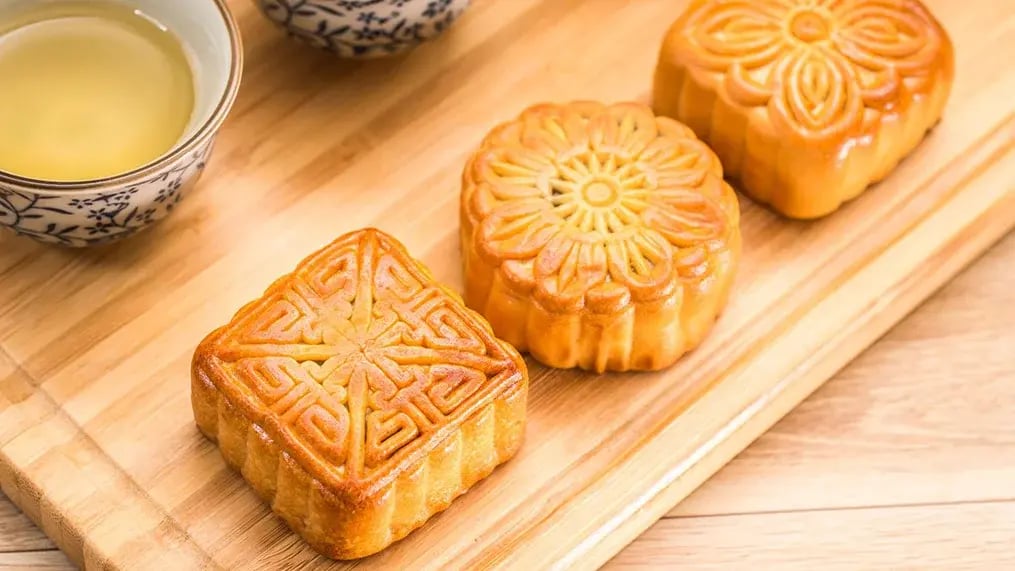
While mooncakes today are enjoyed as a sweet treat, they once played a pivotal role in changing the course of history. During the 14th century, China was under Mongol rule by the Yuan Dynasty. However, Chinese revolutionaries were plotting to overthrow their oppressors and restore a Han Chinese empire.
It was in this turbulent period that the humble mooncake became an unlikely hero. The revolutionaries came up with a covert plan to communicate secretly using the popular Mid-Autumn Festival snack. Some accounts say they hollowed out the mooncakes and hid secret messages inside. Others suggest they carved coded symbols onto the top of cakes, which followers could piece together like a puzzle.
No matter the exact method, these stealthy mooncakes allowed the revolutionaries to coordinate uprisings across China against the Yuan. Through the people's quiet acts of baking and sharing during the festival, messages spread far and wide. Ultimately, this grassroots campaign helped the revolutionaries successfully overthrow the Mongol Yuan Dynasty in 1368. The Ming Dynasty was established, restoring native Chinese rule.
What is So Special About Mooncakes?
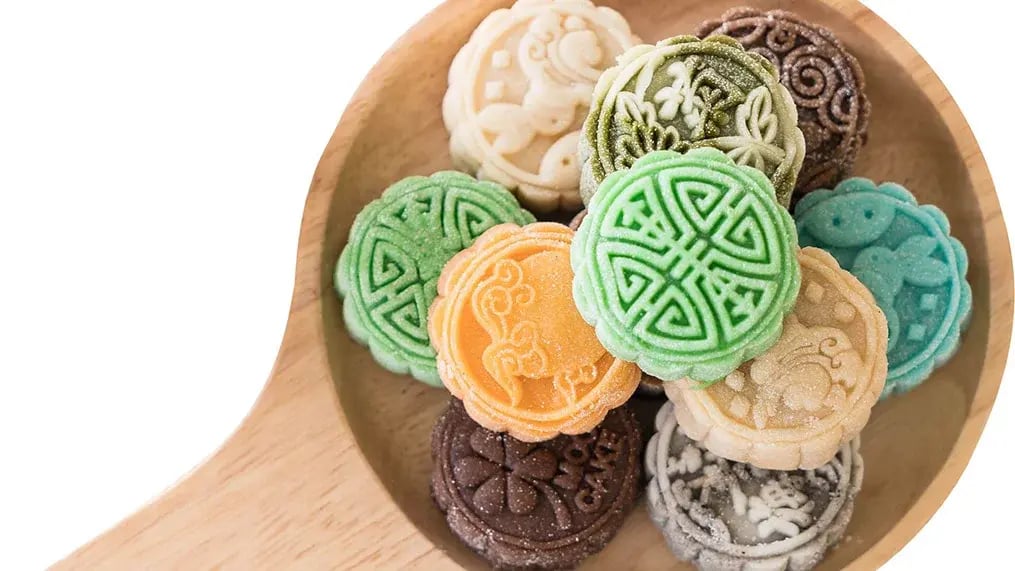
Traditional mooncakes are typically about 10 cm in diameter and 3-4 cm thick. They have a dense, crumbly crust that encases a smooth filling. Some are elegantly decorated on top with Chinese characters or icons related to the Mid-Autumn Festival. More modern mooncakes come in smaller bite-sized pieces or unusual shapes.
Today, mooncakes come in a wide variety of flavors, fillings and designs. Some popular classic fillings include lotus seed paste, various nut pastes, and sweet bean paste. However, there is now a huge range of innovative flavors as well such as green tea, coffee, cheese, and durian.
Texture-wise, quality mooncakes have a balance of flaky crust on the outside with a rich, creamy filling inside. The crust should break apart easily in your mouth, while the filling has a smooth, silky texture. Flavor-wise, the best mooncakes are aromatic and subtly sweet without being cloying. The flavors of filling and crust should complement each other.
Mooncakes in India
There exists a bustling but small community of Chinese settlers whose descendants continue to live on, where their immigrant predecessors had settled down. The community might have dwindled with time, but they continue to celebrate festivals like the Chinese New Year, Lunar New Year, and the Mid-Autumn Festival.
Mooncakes are made and sold in the old Chinatown pockets of Kolkata, where most of the Chinese community in India is concentrated. They make an appearance during the Mid-Autumn Festival every year, where the festival is celebrated in all its pomp and glory. The mooncakes might not resemble the striking embossed ones that we know of, as they look more like puff pastry, but they have their original taste.
Some Regional Styles Of Chinese Mooncakes
Cantonese Mooncake: This regional version of mooncake features a thin, golden-brown skin embedded with intricate patterns. Filled with the white lotus seed paste, red bean paste, and salted egg yolks, this Cantonese version is an absolute delight.
Suzhou-Style: This multi-layered version is all about enjoying a flaky pastry crust. Here, the difference lies in the filling. Instead of the common fillings, it has savory minced pork or sweet bean pastes.
Yunnan Mooncake: Also known as the flower-and-ham mooncake, this regional edition features salty, cured ham, honey, lard, and sugar. Sometimes this recipe also includes edible roses to create a non-traditional flavor profile to balance the savory ham with some sweetness.
Beijing Mooncake: This version is famous for the signature firm red (Zilaihong) and white (Zilaibai) skin. The filling here contains rock sugar, nuts, and candied tangerine peel, and sesame oil.
Exploring The Different Types Of Mooncakes Around The World
Japanese Momoyama: This crumbly, Japanese interpretation of the Chinese mooncake comes with a healthier approach, as it contains less fat. Moreover, here the flour-based crust of the cake is replaced by a white bean paste.
Vietnamese Bánh Trung: The Vietnamese version brings in a baked (bánh nướng) and sticky rice (bánh dẻo) spin to the traditional recipe. Here, the cake features a chewy and toasted glutinous rice flour crust. The filling often contains lotus or mung bean paste.
Philippine Bakpia: The Philippine people have turned the Chinese mooncake into a cheaper, circular, and flat crust pastry that is filled with delicious mung beans and sometimes with exotic fillings like purple yam, jackfruit, and cheese.
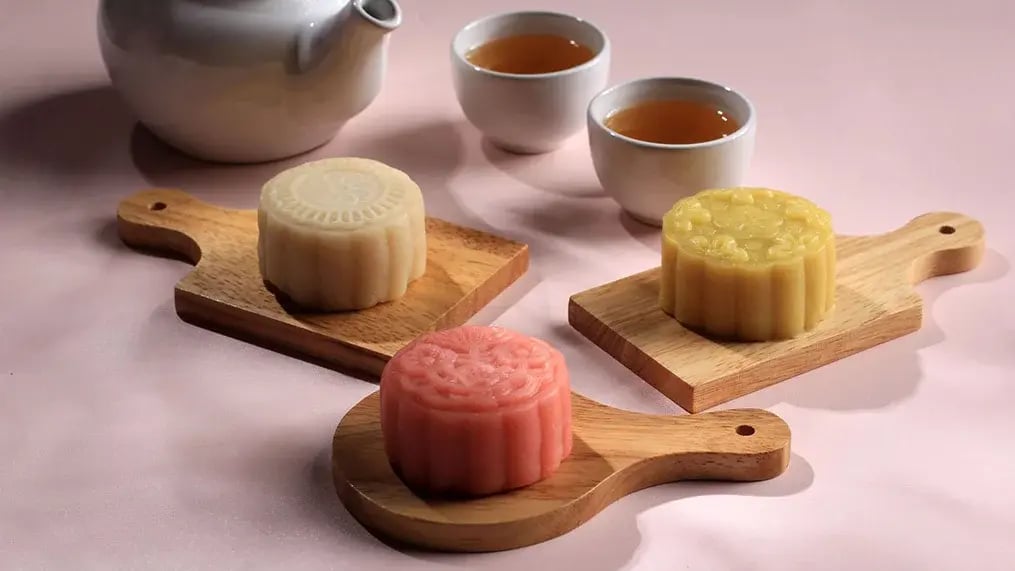
Hong-Kong Snow Skin: Often served chilled, this non-baked, colorful version has a glutinous rice flour crust filled with fillings like fruit and cream custard.
Frequently Asked Questions
Is mooncake good for diabetics? 
While traditional mooncake recipes are not good for people with diabetes, as they contain high sugar, fat, and carbohydrates. However, diabetics can still either enjoy them in small amounts or they may tweak the recipe and make it low-sugar.
What is the significance of mooncakes in Chinese culture?
In Chinese culture, mooncakes are an integral part of the Mid-autumn harvest festival that celebrates reunion, prosperity, and harmony. Here, the round shape of the cake mimics the moon and is exchanged as a symbol of gratitude.
What is the Mid-Autumn Festival, and how are mooncakes connected to it?
The Mid-Autumn Festival is a major Chinese harvest festival celebrated on the 15th day of the 8th lunar month. The full moon is usually celebrated with friends and family to honor the moon goddess. And, the celebrations are incomplete without mooncakes, as it is a symbol of unity and gratitude.
What are the most traditional mooncake fillings?
The most traditional and common mooncake filling options include lotus seed paste, red bean paste, and five kernel made with mixed nuts and seeds. Often paired with salted duck egg yolk, these fillings are simply delicious.
Why do mooncakes have an egg yolk in the middle?
The salted egg yolk in the center of a mooncake symbolizes the full moon during the Mid-Autumn harvest festival. Besides the cultural significance, it also balances the sweetness of the surrounding lotus seed or red bean paste.
Like This Article?
More Like This


Popular Articles


Trending Web Stories


Curated Recipes